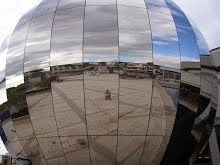
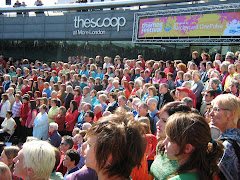
The Buttercross, Chippenham Market Place - February 2008
There are 2 Chippenhams in England. I live in the one in the South West, 100 miles west of London and 10 miles east of Bath. It’s in Wiltshire, a rural county of around half a million people – the least densely populated county in the south-west. The county town surprisingly is Trowbridge, most outsiders think it’s Salisbury because of the famous cathedral. The largest town is Swindon, one of the country’s ‘new town’ expansions of the 1960s, now with a population of 115,000.
Wiltshire is a land of mysteries and weird happenings – from ancient monuments like Stonehenge and Avebury, the famous white horses up on the chalk hills, through to more modern phenomena such as UFO sightings and crop circles. Native Wiltshire people proudly call themselves Moonrakers, after the legend of local smugglers hiding their booty in a village pond in the 1700s and telling customs & excise they were raking the water for the big cheese (the moon) they could see there. It seems that every Wiltshire village with a pond lays claim to theirs being the original!
Wiltshire’s geology is described as ‘chalk and cheese’ – the ‘chalk’ refers to the limestones of the Cotswolds to the north of the county and the southern county's chalk downlands (which are really uplands relatively speaking!). Both areas are famous for their sheep and wool production. The ‘cheese’ refers to the river vales incising through the Jurassic and Cretaceous rocks, such as the River Avon of my home town. Cattle farming is the main activity of the ‘cheese’ areas. There’s also strong market gardening activity around the village of Bromham, 5 miles from Chippenham, so this is the source of most of the seasonal vegetables in our local shops.
Like most of England, Wiltshire’s climate is a mild, temperate one owing to the influence of the Gulf Stream – we’re on the same latitude as Canada, yet we’d be classified as zone 9a by the USDA. The prevailing wind is south-westerly, bringing us moist, warm air from the tropical Azores. The influence of the Severn estuary 25 miles west of us, also accentuates the mild, damp climate. So, it’s a great place to have a garden and allotment!
Chippenham is a market town of 30,000 people. The name originates from the Anglo Saxon 'Cyppa's Hamme' meaning - low lying land in a river bend belonging to Cyppa. It’s Town Charter was granted by Queen Mary in 1554, but it goes back much earlier than that. King Alfred the Great had a hunting lodge here in the 800’s and his sister married the King of Mercia in the local church, now St. Andrew’s. Market days are on Fridays and Saturdays, though these are much poorer affairs today since the closure of the cattle market a few years ago. I took my driving test on market day in the 1980s and spent half of it sitting in a traffic jam. That wouldn’t be the case today.
Chippenham can be a strange place – anywhere that has an Eddie Cochrane festival each year because the man was killed following a road traffic accident in the town has to be a wee bit odd! It’s quirkiness is reflected in the style of the local newspaper and some of the advertising and graffiti I’ve found recently. It also has an international folk festival at the end of May, when the town has a friendly invasion of folk singers, musicians and dancers – mainly of the Morris variety.
Garden-wise, Chippenham has 2 main public gardens, John Coles Park and Monkton Park. John Coles Park is a typical public space dating back to Victorian times and has regular concerts in the bandstand on summer Sundays. I can hear them on my allotment half a mile away when the wind’s in the right direction. Monkton Park is right in the centre of town and was formerly the grounds of a rather grand house. As a result there are lots of rather stately trees, plus walks by the side of the river. It also houses the local council offices, sports centre and a 9 hole par 3 golf course.
Like most of Wiltshire, I garden and allotmenteer on a limy soil (pH > 6.5) and like most Chippenham gardeners my soil is a clay one. There’s a thriving Allotment and Garden Society, looking after 6 allotment sites in the town. We have a monthly talk or social event, plus access to discounted seeds and plants. Our local garden centre is a couple of miles away and has a Garden Club too.
Chippenham is a fantastic base to explore south-western England. We're close to Stourhead, the world-class landscape garden, and Hidcote Manor whose garden celebrated its centenary last year. Smaller gardens such as The Courts, Abbey House Gardens and Lacock Abbey have their own treasures and pleasures. Many garden enthusiasts also open their gardens to raise funds for charity under the famous Yellow Book scheme. Glorious landscapes; stately homes such as Longleat, Wilton and Corsham Court; plus towns and villages like Castle Combe, Devizes and Lacock add to the county’s riches. You’ve probably seen some of our treasures already as Wiltshire is frequently used as a film location. The next Harry Potter was filmed in Lacock last year, Stardust at Castle Combe and The Other Boleyn Girl at Lacock in 2006. It’s also frequently used for classic television costume dramas, such as Cranford and Pride and Prejudice. Sir Anthony Hopkins will be filming in Lacock next month (April 2008).
I write about Chippenham regularly in my
Veg Plotting blog. I’m currently documenting the changing face of Chippenham in photographs as the town is undergoing major changes to its infrastructure and way of life. You’ll find these and more under the Chippenham Label. I also have Chippenham related links in my sidebar there – map, town guide, weather and the local newspaper. I'm also publishing photos of my garden and allotment on a fortnightly basis this year, under the title Plot Views. I've also provided plenty of great links in this article, should you wish to explore further. I do hope you‘ve enjoyed your visit to my town and will join me again!


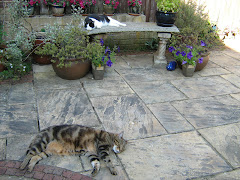
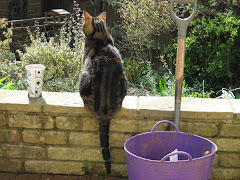
 As well as a liking for boxes, Skimble’s a foot fetishist – he curls round my feet, licking then biting them, purring away like mad. He also likes to sit on me under my tapestry frame when I’m doing my needlepoint. Initially he chases the wool and finally falls asleep with his paws curled over my leg. He also has an endearing habit of snoozing with one paw over his eyes. He loves collecting elastic bands, finding the ones our postman leaves on the streets during his round. He brings them in with as much excitement and ceremony as the VILs. He’ll tread on me for ages if given the chance, preferably with his nose up my armpit. He’s also fascinated by watch glass reflections made on the wall by sunlight – he’ll jump and chase them all over the place. So much so, that NAH has bought a laser pointer for him to chase the red dot – eventually into NAH’s slippers at the end of the game.


 The Mexican is perched on our patio wall and forms a focal point leading into the garden from the garden's side entrance, where he is framed within a pergola. I'll be showing you the side garden and pergola next month as part of a very exciting blogging project I'm working on at the moment.
 I love the sea and a lot of my pots are blue, so this starfish was a must have.
 The garden is on a limestone bedrock and I often find fossilised corals in the brashy stone when digging. Therefore a replica ammonite was a natural addition to my finds from the garden.
 I also have a number of wild animals, some of which also occur in the garden in their natural form, such as frogs. Most of these are hidden and my niece loves to find and count them all when she visits. Some are hidden so well, I couldn't find them when taking the photographs for this piece!
 Not all of my objects are 'natural' garden ornaments. This is one of a pair of finials I picked up cheaply at an auction. Normally they would be fitted on a gatepost pillar, but I thought they'd make a different 'full stop' to the narrowing borders either side of the steps down to the lower patio.
 Most of my garden whimsy serves absolutely no practical purpose at all, except to amuse me. However, the decorative trellises below are being used to add interest to the vast swathes of fencing we have bordering our property where there is no soil available to grow plants. These are down one of the sets of side steps off the patio.
 Below is another practical example used to protect some wooden posts from rotting and reminds me of the Arabian Nights.



.jpg)