Showing posts with label Archive Hour. Show all posts

Wednesday, 16 July 2008

From the Veg Plotting Archives...

Tales from our Sing For Water Preparations:
Reviews of books available in the grand giveaway:
Posts to help with your orientation and trip around the garden:

Rehearsals Start - 3rd June 2008

Hmmm, I think I need to clean that out...

My regular choir's finished for the summer now, but I've joined another one that's formed temporarily to Sing for Water, raising money for WaterAid. There's about 70 voices drawn from several choirs across Wiltshire and we have just 6 weeks to learn 7 songs. In reality it's 3 weeks to learn them as the last 3 weeks will be polishing the songs to performance standard. We met in Trowbridge for the first rehearsal on Tuesday night - 2 songs down, 5 to go! There were 3 choir leaders there, so the way of learning the songs was quite different to what we've been used to as the different parts could be learnt pretty much at the same time instead of our usual in turn. Our local performance takes place on 8th July and we'll then be going to London in September for the big Sing for Water concert at The Thames Festival, where a choir of 1,000 voices will be performing.

We learnt a E Marabini, a South African song on Tuesday - with a really catchy, cheerful tune. However, the translated lyrics are quite sad:

What has happened with the Marabini dance. It has taken them away. We will look after this child because it indeed, has no parents.

The other song was called Talk to Me and consisted mainly of the women singing 'Talk to me' and the men going 'Dum dum dum dum' - sounds familiar eh?

BBC Radio Wiltshire was there and will be returning to record most of the rehearsals, plus hopefully the concert itself. Chris, our choir master was interviewed by them last week and said there are quite a few people who haven't sung before who will get to performance standard in the time we have - well that happened to me last year and it's happening right now to one of NAH's ex-colleagues who's joined the choir. The radio wants to see if Chris' claim comes true - so it feels a bit like one of those choir reality shows that's been on the telly recently. We had a lady dressed in pink waving a microphone in the middle of us all for 2 hours on Tuesday night - and she nearly ran me over in her radio car on the way in to where we're rehearsing!

The Practice CD

Half way through rehearsals having gone through each song at least once, we were given a practice CD containing all the songs. There's a track for each part for a song, plus one with all the parts combined. Some of the parts are also split (so we're singing eight part harmony instead of the usual 4-part), so for these songs you have to listen carefully for which speaker your allotted split part has been allocated to. It means lots of concentration is needed, even at home.

I have to sneak in my home practising as NAH doesn't like to hear me singing. Luckily, he goes swimming training in the morning on a regular basis, so I have a quick half an hour going through each song before he comes home. I have tried singing along in the car, but gave up after I was so busy singing on the way to rehearsals, I missed the turning to Trowbridge and went off to Warminster instead!

Focus on the Horizon - Ist July 2008

The 12 Apostles, Great Ocean Road, Victoria, Australia - December 2003 (11 since 2005, the first one's now rubble)

This piece was written as part of the monthly Garden Bloggers Muse Day - an optional meme held on the 1st day of the month, where bloggers offer a piece of prose or poetry appropriate to their thoughts or mood.

I'm a non-gardening muse today, but I'm sure that doesn't matter. I had initially toyed with presenting Pam Ayres' I Wish I'd Looked After My Teeth after a particularly bad tussle at the dentist's yesterday which is still painful. However, he's assured me that I do look after my teeth rather well, so it's not really appropriate.

Instead I've chosen a song for you today. It's one of the ones we'll be rehearsing tonight for next Tuesday's Sing for Water concert. Unfortunately this particular song hasn't been on the radio as part of our regular broadcasts, so I can't reveal the wonderful sound of it - yet. However, I love the words of this particular song. It's very simple and the writer (Roxanne Smith) has managed to re-create the impression of waves with the way she's woven the music around them. But I think the words speak for themselves too and also chime with the more philosophical muse I've been lately. Our recent holiday proved how by removing ourselves from everyday life for a while, the important things become much clearer - as in the song's 'focusing on the horizon'. Now we've been 'carried back to the shore', both NAH and I are much more at peace.

I need to gaze out beyond the sea
To focus on the horizon
Let the water lift me up
And carry me to the shore

Let the waves, carry me (gonna)
Let the water, carry me (carry me to the)

I need to gaze out
To focus
Let the water
Carry me to the shore

The Concert - 8th July 2008

Our weeks of hard work paid off on Tuesday night and we gave our all for the performance. I had an absolute blast and it seems to have gone down well, judging by the audience's reaction and the piece on yesterday's radio. The whole concert will be broadcast at some point - I'll let you know when that happens. Hopefully it'll include the set from our support act The Chausettes which included Chris and Ali, two of our choirmasters. Their finale Hit Me Baby One More Time had me in fits of giggles, especially when Chris was a Bass version of Britney Spears!

Like all good fundraising concerts we also had a very moving film about Wateraid's work and the following extract from Chris' e-mail to us all yesterday sums up what we've achieved so far:

You have every right to feel extremely proud of yourselves for last night. I knew it was going to be OK after our run through, but the performance exceeded all my expectations. You sounded fabulous, looked gorgeous and also seemed to have a good time too (the audience always pick up on that).

We also collected nearly £600 on the door and will almost certainly make £1,500 with the ticket receipts. Add this to the Bristol profits and we're looking at over £4,000 from the two concerts. If we hit the average minimum target of £50 a singer in sponsorship (and many of you have already raised more than that), we can add £10,000 to the money we've raised.

You can see from the film last night that that will have a significant impact.

You have made a difference.

Thank you.

Chris, Candy and Ali *

Now for the concert in London on the 14th September!

* = Our choirmasters

Rehearsing for London - 13th September

Tomorrow's the BIG day - the Sing for Water concert in London. So I found myself in Trowbridge at lunchtime for another rehearsal. A number of the songs will be sung quite differently in London - in a much simpler way. Apparently we were given a much more complicated mix for our concert in July to make the performance more interesting. However moving 800-1,000 singers across The Scoop in London (where we'll be performing) can't be done, so I'll be somewhere at the side of choir for tomorrow's performance and there I'll stay.

But our choir masters don't want us to rest on our laurels. So we had a completely new song to learn today, in an African language to boot. Luckily for us, most of the song (Obatala) is calling (i.e. a soloist or group singing the song's verse), and we just sing the response back. It's a catchy number, involving African drummers too. The tempo quickens as we go along, which was a little difficult to master at times, but we have a rehearsal in London at 9.30 am tomorrow to put the final polish on the song. That means we leave Corsham at 6.30 am, a time I previously didn't think existed on a Sunday. I'm grateful Corsham's the final pickup, the Trowbridge singers will be picked up at 6 am. :0

Flushed with Success - the London Concert

One of the more unusual volunteer opportunities WaterAid has on offer

I re-discovered a number of things I'd forgotten on Sunday (14th September) - getting up in the dark, the 5.30 am Shipping Forecast on Radio 4, mist laden fields and empty roads. They were all worth it for the experiences later on that day. Sing for Water forms part of the Thames Festival - an end of summer extravaganza held on the banks of the river. A heady mix of dance, world music, stalls on all sorts of watery themes and of course song. All of it free, except for the food and drink. It's really hard for me to adequately describe the day - except to say it was one of the best, ever. I hope the following pictures will give you a flavour.

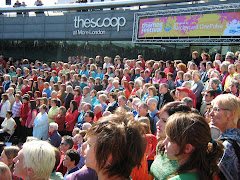
1,000 people in rainbow coloured tops with nothing to do but sing our hearts out...

... to an audience of 1,500+, who gave us a standing ovation at the end...

... conducted by Michael and Roxanne (who wrote Focus on the Horizon), exaggerating every movement so we could all see what was wanted...

... right in the heart of London opposite where Zoe could see from her perch on the Epsom Downs...

... with some of you actually making donations over at my Open Garden whilst we were singing. Thank you so much! You've helped to exceed my second target of £750. Today (16th September 2008) the donations stand at £813. Shall we go for a third target of £1,000? Oh yes, I think so.

101 Bold and Beautiful Flowers

I originally reviewed this book over on Veg Plotting in June. James has kindly donated a signed copy of his book for the prize draw I'm having for those of you who have generously given a donation.

As a reader of Gardeners' World magazine, I always look forward to the We Love (insert current month) for.. feature, not only for the luscious pictures of must-have plants, but also to read the accompanying words of the 'master of the simile', James Alexander Sinclair (JAS).

Now Gardeners' World has branched out into the world of books, bringing out a series of (largeish) pocket guides for less than a fiver on the theme of 101. Thankfully these have nothing to do with the Orwellian room of doom and are much more useful, brimming with ideas for projects, pots, shady or problem places and growing to eat. JAS brings us the latest in the series, the pictured 101 Bold and Beautiful Flowers.

The book is divided into colour-themed sections, thus helping gardeners to easily match flowers into their current plantings, or to produce a whole border or garden from scratch. There are selections of choice bulbs and perennials and I'm glad to see annuals have not been left out of the equation - providing those welcome fillers whilst a garden develops or this year's fireworks highlight. Many of the plants will already be familiar to most gardeners, but the book's strength is to suggest a less well known variety - take the pictured front cover as an example. The usual Helenium on offer is 'Moerheim Beauty'. Nothing wrong with it, but it's in pretty well everyone's border. JAS suggests 'Rauchtopas' instead, describing its daisy shaped flowers as 'the reddish buff of burnt toffee, while the dark brown centre of each flower could be a chocolate-covered caramel rolo'. Doesn't that make you want to buy it right now (along with some accompanying chocolate perhaps)?

In this case you can judge a book by its cover - the standard of the photography throughout is high and the choice of plants throughout never fails to please. Flowering times and cultural notes are also provided, though I would have liked a one-liner summary at the bottom of each page (along the lines of what's seen on plant labels perhaps) to help with garden planning. They can be a little difficult to find at times amongst the sumptuous prose. That minor quibble to one side, it's a book to return to and I'll be using it to help replan some of my borders next year.

I'll leave you with a favourite description of mine - it's for Kniphofia 'Ice Queen'. Now I grew some of the usual Kniphofia from seed when I first had my garden, but ripped the whole lot out a couple of years later as they were an ugly mess for most of the year. I vowed Kniphofia would never darken my door ever again, but this had made me reconsider:

In the case of Kniphofia 'Ice Queen' you could call it Chic Poker. It may not roll off the tongue as easily, but instead of glowing harlot-scarlet flowers there are modish pokers wearing tasteful frocks of greenish-yellow, and the unsophisticated foliage is swapped for neater, spined leaves. It is a poker more likely to be found taking tea at musical salons than loafing around with disreputable sharks in basement billiard halls.

Jekka's Complete Herb Book


This review appeared in Veg Plotting as part of the pre-publicity for this blog.

Jekka McVicar is a national treasure in my view. A herb guru and record breaking multi-gold medal winner at Chelsea, whose nursery is one of the few certified as organic in this country. I met her at one of the open days held at her Herb Farm last year - luckily for me it's not that far from where I live. It was a fascinating day out- it was just before Chelsea, so we got a sneak preview of the plants being grown for her exhibition stand, plus her new seed range 'Reds Under the Beds' to be launched at the show. It's a colourful mix of saladings which we also got to sniff and taste. I also met her lovely cat called Borage - as in the herb pictured above. She personally chose for me the lemongrass plant I have in the garden, as she thought the one I'd picked up wasn't up to standard. She then told me to try wrapping salmon in its leaves before baking in the oven - delicious. So I was already a fan.

Now The Garden Monkey has also persuaded her to donate a signed copy of her latest book, Jekka's Complete Herb Book, for my open garden fundraiser, so her status is now national treasure squared in my view. It's a gorgeous book and Jekka uses the term 'herb' in its widest sense, covering medicinal, culinary and other uses. So plants like Meadowsweet (Filipendula ulmaria) and Betony (Stachys officinalis) have equal billing alongside the more familiar Mint and Thyme.

The bulk of the book is the A-Z of herbs (by botanic name, not common) and covers over 150 plants. You'll find plenty of history and folk-lore alongside the expected details on cultivation, harvesting and uses. There's recipes too - I've sneakily written down the one for lavender biscuits as I'm intrigued by it and also the instructions for pickling Nasturtium seeds as my plot is overrun with them this year. After the A-Z, there's a shorter, more general section covering propagation, planning a herb garden (including several designs), container growing, pests & diseases, harvesting, using herbs as natural dyes plus instructions for making herb oils, vinegars and preserves.

The text is clearly laid out whilst packing a lot of information into each page. The photographs are beautiful too. I think it's a perfect gift for a complete beginner or an expert and I think you'll be looking at a number of the plants in your garden with fresh eyes, OR finding somewhere to squeeze in 'just a few more herbs that'll come in handy' into your garden. As it's a book I'm going to find extremely hard to part with, I've decided you've got to make it worth my while. Therefore, it'll go to the person giving the highest donation to this blog. In the event of a tie, I'll draw the name out of a hat.

And if any of you are in the Alveston area on the weekend of 29-31 August, I'd recommend popping in to Jekka's Herb Farm as it's the last open weekend for this year - if not, she does do mail order too. See you there!

The Allotment Keeper's Handbook


This review first appeared in Veg Plotting on 4th September 2008.

It's been a rainy day here in Chippenham, so I've had a chance at last to catch up with some of my 'book log' (i.e. book back log). I always have a number of books on the go at one time, with a number forming an orderly queue behind them. Leaping over them all in an effortless bound today is Jane Perrone's The Allotment Keeper's Handbook. It forms part of my Open Garden prize book stash, so demands a review without further ado.

Peruse the gardening shelve(s) in any bookshop at the moment and the number of titles on the subject of food growing and allotmenteering has (pardon the pun) mushroomed in the last couple of years or so. This title is a relative newcomer (published last year) and came after the time I was in search of my own allotmenteering bible. However, I've been enjoying Jane Perrone's blog Horticultural since I started blogging, so I was delighted when The Garden Monkey persuaded her to part with a signed copy for me to give away sometime in the next few weeks.

Unlike most of the books in this genre, The Allotment Keeper's Handbook falls into the practical sized volume - neither coffee table glossy nor impossibly large. It feels like it should have the reassuring words Don't Panic written on the cover in the style of Hitchiker's Guide to the Galaxy. This is a book written from personal experience aimed at the beginner allotmenteer. It feels like you have that allotmenteering friend to show you the ropes right there in your hand - the friend I didn't have when I started my allotment 4 years ago.

This is a book that cuts right through the jargon, packing a lot of information, advice, anecdote and humour into a relatively small size. You won't find many photographs along the way, but that doesn't mean the book isn't useful. In fact it leaves the way clear to get the novice allotmenteer thoroughly started - from getting the right plot, cultivating it, right through to the final, satisfying harvest. There's also plenty of new information to keep relative old hands like me interested, such as the reputed use of carrots to attract nematodes away from the cucurbit family. This is the book to help you get your allotment licked into shape. Partner it with Joy Larckom's classic Grow Your Own Vegetables for more details on specific crops and you'll have the best help possible to get you started on your plot.

Sadly Jane has given up her allotment since writing this book. I wish her well in developing her new vegetable garden from scratch at her new home.

New Gardening - How to Garden in a Changing Climate

This review was posted at the end of March after I'd won this excellent book in another giveaway. Happily The Garden Monkey has again managed to persuade the author to part with a copy for this one - a signed copy this time. Since this review, I've learned that the book has been awarded Practical Gardening Book of the Year 2007 and Matthew Wilson has taken up a high profile new role (Head of Gardens Creative Development) in the Royal Horticultural Society (RHS).


I was lucky enough to be the first winner in The Garden Monkey's (GM) Big Bash Books a couple of weeks ago and bagged this one as my prize of choice. It caused quite a stir on its publication at the back end of last year and has been on my 'To Read List' ever since.

It sets out to redefine the RHS' best practice and its author Matthew Wilson, has been at the forefront of shaping this during his time as Harlow Carr's Curator. He looks at how we can garden in harmony with nature whilst reducing our impact on the environment. You may think he's preaching to the converted, but believe me there's plenty of gardeners out there who don't have this enlightened way of thinking if Chippenham's anything to go by. Sustainable it ain't.

The book starts with a look at climate and the soil, a refreshing starting point - these vital elements are often overlooked; then the themes of sustainability, wildlife gardening, and gardening in a drier climate are tackled. Trees, shade and container planting are looked at alongside planting styles, design and planting partners. Each chapter is broken down into a series of sumptuously photographed double page spreads, making it a highly 'dippable' book as well as one to read from cover to cover. This dippability was thoroughly put to the test by my blogging buddy Threadspider plus my SUP group (needlepoint and crafting friends) recently - the book and several of the projects are now on various 'To Read/Do Lists', including the log pile seat on mine and the rather nattily wood clad shed on another.

GM asked me a couple of weeks ago how I was enjoying the book. My initial reaction back then was it's a brave book for the stuffy old RHS to tackle. Having thought about it further (and finished the book), I believe it's exactly the kind of publication they should be doing. After all, their other books and website are often my first ports of call when I want to find out something. That's also why I use their website as a good source of links for my posts. Perhaps they're not so stuffy after all!

It's not a perfect book - there's concrete alongside rammed-earth raised beds and the planting lists aren't that extensive. However, I believe this makes the book much more approachable for anyone wanting to start to garden in this way who also needs a helping hand to begin. It covers a wide range of topics so I'm also sure there's something in there for all of us.

Where Am I Veg Plotting?

The Buttercross, Chippenham Market Place - February 2008

There are 2 Chippenhams in England. I live in the one in the South West, 100 miles west of London and 10 miles east of Bath. It’s in Wiltshire, a rural county of around half a million people – the least densely populated county in the south-west. The county town surprisingly is Trowbridge, most outsiders think it’s Salisbury because of the famous cathedral. The largest town is Swindon, one of the country’s ‘new town’ expansions of the 1960s, now with a population of 115,000.

Wiltshire is a land of mysteries and weird happenings – from ancient monuments like Stonehenge and Avebury, the famous white horses up on the chalk hills, through to more modern phenomena such as UFO sightings and crop circles. Native Wiltshire people proudly call themselves Moonrakers, after the legend of local smugglers hiding their booty in a village pond in the 1700s and telling customs & excise they were raking the water for the big cheese (the moon) they could see there. It seems that every Wiltshire village with a pond lays claim to theirs being the original!

Wiltshire’s geology is described as ‘chalk and cheese’ – the ‘chalk’ refers to the limestones of the Cotswolds to the north of the county and the southern county's chalk downlands (which are really uplands relatively speaking!). Both areas are famous for their sheep and wool production. The ‘cheese’ refers to the river vales incising through the Jurassic and Cretaceous rocks, such as the River Avon of my home town. Cattle farming is the main activity of the ‘cheese’ areas. There’s also strong market gardening activity around the village of Bromham, 5 miles from Chippenham, so this is the source of most of the seasonal vegetables in our local shops.

Like most of England, Wiltshire’s climate is a mild, temperate one owing to the influence of the Gulf Stream – we’re on the same latitude as Canada, yet we’d be classified as zone 9a by the USDA. The prevailing wind is south-westerly, bringing us moist, warm air from the tropical Azores. The influence of the Severn estuary 25 miles west of us, also accentuates the mild, damp climate. So, it’s a great place to have a garden and allotment!

Chippenham is a market town of 30,000 people. The name originates from the Anglo Saxon 'Cyppa's Hamme' meaning - low lying land in a river bend belonging to Cyppa. It’s Town Charter was granted by Queen Mary in 1554, but it goes back much earlier than that. King Alfred the Great had a hunting lodge here in the 800’s and his sister married the King of Mercia in the local church, now St. Andrew’s. Market days are on Fridays and Saturdays, though these are much poorer affairs today since the closure of the cattle market a few years ago. I took my driving test on market day in the 1980s and spent half of it sitting in a traffic jam. That wouldn’t be the case today.

Chippenham can be a strange place – anywhere that has an Eddie Cochrane festival each year because the man was killed following a road traffic accident in the town has to be a wee bit odd! It’s quirkiness is reflected in the style of the local newspaper and some of the advertising and graffiti I’ve found recently. It also has an international folk festival at the end of May, when the town has a friendly invasion of folk singers, musicians and dancers – mainly of the Morris variety.

Garden-wise, Chippenham has 2 main public gardens, John Coles Park and Monkton Park. John Coles Park is a typical public space dating back to Victorian times and has regular concerts in the bandstand on summer Sundays. I can hear them on my allotment half a mile away when the wind’s in the right direction. Monkton Park is right in the centre of town and was formerly the grounds of a rather grand house. As a result there are lots of rather stately trees, plus walks by the side of the river. It also houses the local council offices, sports centre and a 9 hole par 3 golf course.

Like most of Wiltshire, I garden and allotmenteer on a limy soil (pH > 6.5) and like most Chippenham gardeners my soil is a clay one. There’s a thriving Allotment and Garden Society, looking after 6 allotment sites in the town. We have a monthly talk or social event, plus access to discounted seeds and plants. Our local garden centre is a couple of miles away and has a Garden Club too.

Chippenham is a fantastic base to explore south-western England. We're close to Stourhead, the world-class landscape garden, and Hidcote Manor whose garden celebrated its centenary last year. Smaller gardens such as The Courts, Abbey House Gardens and Lacock Abbey have their own treasures and pleasures. Many garden enthusiasts also open their gardens to raise funds for charity under the famous Yellow Book scheme. Glorious landscapes; stately homes such as Longleat, Wilton and Corsham Court; plus towns and villages like Castle Combe, Devizes and Lacock add to the county’s riches. You’ve probably seen some of our treasures already as Wiltshire is frequently used as a film location. The next Harry Potter was filmed in Lacock last year, Stardust at Castle Combe and The Other Boleyn Girl at Lacock in 2006. It’s also frequently used for classic television costume dramas, such as Cranford and Pride and Prejudice. Sir Anthony Hopkins will be filming in Lacock next month (April 2008).

I write about Chippenham regularly in my Veg Plotting blog. I’m currently documenting the changing face of Chippenham in photographs as the town is undergoing major changes to its infrastructure and way of life. You’ll find these and more under the Chippenham Label. I also have Chippenham related links in my sidebar there – map, town guide, weather and the local newspaper. I'm also publishing photos of my garden and allotment on a fortnightly basis this year, under the title Plot Views. I've also provided plenty of great links in this article, should you wish to explore further. I do hope you‘ve enjoyed your visit to my town and will join me again!

Our Skimble & Jess

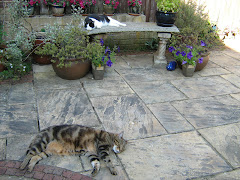
They’re our second pair of cats, a brother and sister born in January 2001, who joined us in late February the same year from a nearby cat rescue shelter. Sadly we left their mother plus 3 brothers and sisters behind, but they all found good homes – we know they must be good because of the owner vetting process we had to go through!

Both are going through the ‘spring madness’ at the moment (this was March 2008): Jess chases randomly about the house and Skimble has found his tail again and chases it incessantly. Skimble’s also bringing us regular presents of the reddest Photinia x fraseri ‘Red Robin’ leaves he can find in the garden. He announces their arrival with much fussing and meowing. This habit’s so pronounced, we call each one a ‘Very Important Leaf’ (VIL).

Jess is named after the cat owned by Postman Pat – how unoriginal we are! We took longer to name Skimble - after T.S. Eliot’s poem, Skimbleshanks The Railway Cat. This was the first poem that NAH learnt by heart as a child and I’m sure if our Skimble lived by a railway, he’d be ‘busy in the luggage van’ too. He’s twice the size of Jess, 13 pounds in weight to her 6. You certainly know it when he lands on your lap!


Here you can see Jess’ audition to be the next Felix pin up. I’m sure the call will come any day now. She’s the brains of the outfit, having worked out how to open a half locked cat flap when set to incoming cats only. She’s also the talkative one - Skimble’s the strong silent type, though both have purrs like engines. She loves milk, yoghurt, cheese, pasta sauce, soup, curry, porridge - even cider on one memorable occasion. She’s an avid watcher of wildlife programmes and was glued to the tiger documentary last Sunday. She licks my head (we say she has a licker problem - she also has the swishiest of tails) when I’m in the bath or sitting on the sofa. She’ll also come and wake me up in the morning when NAH’s downstairs getting the breakfast and leaving me to have a lie in - vigorous treading, purring loudly in my ear and sitting on my head’s her usual technique.

As well as a liking for boxes, Skimble’s a foot fetishist – he curls round my feet, licking then biting them, purring away like mad. He also likes to sit on me under my tapestry frame when I’m doing my needlepoint. Initially he chases the wool and finally falls asleep with his paws curled over my leg. He also has an endearing habit of snoozing with one paw over his eyes. He loves collecting elastic bands, finding the ones our postman leaves on the streets during his round. He brings them in with as much excitement and ceremony as the VILs. He’ll tread on me for ages if given the chance, preferably with his nose up my armpit. He’s also fascinated by watch glass reflections made on the wall by sunlight – he’ll jump and chase them all over the place. So much so, that NAH has bought a laser pointer for him to chase the red dot – eventually into NAH’s slippers at the end of the game.

Both of them loved sitting on top of the PC monitor and were most confused when we went flat screen. Nowadays Skimble tends to sit at my feet when I’m working on the computer. I always know when NAH’s arriving home as Jess has a special meow that she makes at no other time. She also rears up on her hindpaws when you stroke her. Both are fluent in Spanish as I used to chat away to them when I studied the language. They love to help around the house being particularly proficient at bed ironing, especially any jumpers, fleeces, trousers and pyjamas we leave there. They love reading the newspaper, especially if they can scan it through their bottoms. Naturally they’re extremely good at gardening – that’s why they’re our ‘Garden Helpers’ ;)

Introducing Our Patio

Click on the collage to see a larger image if wanted

Clockwise from top left: 1. Looking East 2. Circle & brick detail 3. Looking West
4. Wall top detail 5. House brick colours 6. Edging detail 7. Central steps up to patio
8. Wall top & edging detail 9. Central steps entrance pillar detail + accessories

I thought I'd share with you some of the thought processes that went into our final patio design. We moved here in 1999 to a complete blank canvas as the house was newly built. All we had was a 15 metre (approx 50 feet) square garden, newly turfed except for a line of paviors across the back next to the house and some steps set into a steep bank about a third of the way in. The garden's on a slope (about 1 in 10), so initially we weren't quite sure where to start, but knew that the slope gave us the potential to put together a good design with a 'wow factor'

So we sat just looking at it and scratching our heads for a year, often sitting on the steps to get the feel of being in the middle of it all. The builders had made a large flat area next to the house cut diagonally across the garden. That helped us to make our first couple of decisions - to keep most of the flat area as the patio and to retain its diagonal line. We also knew we'd need to retain the steps to get us to the next level of the garden - in fact we ended up with 3 sets of steps from the patio, so we could have 'a journey' round the garden. Step sitting's still one of my favourite places (especially at dusk when the bats are out), in spite of the many inviting places we have on the patio itself now.

With those ideas in mind, I put together many rough sketches (back of fag packet more like) to discuss with NAH. Finally we were both happy with one of them, but knew the amount of construction work involved needed us to GAMI (get a man in). The drawing we got back from our chosen GAMI, not only took our design, but improved it. It was his idea to put the S curve into the patio's shape.

Next we had to think about materials - our house is mainly red brick with yellow brick details, so we thought it would be good to reverse those colours for the patio. We chose a pavior that's close in colour to both the yellow brickwork and the big chunks of local stone we keep finding in our soil, with a small red 'cobble' plus a red brick for contrast. As the patio is so large (Across the whole width of the garden and 27 feet at its widest point, tapering to a mere 6 and a half feet at the other end), I thought we needed to break up the expanse a little using a several pavior sizes set randomly throughout the area and I also liked the idea of an inset circle in the widest part.

We also decided to have a low dividing wall between the patio and the next part of the garden - the terrace bedding either side of the central steps. It was GAMI's idea to add the pillars at each side. Finally, we added just one small planting area (GAMI had suggested several initially) at the eastern end, to enable me to grow strawberries and herbs (this was pre allotment days) plus some climbers up the wall of next door's garage. 8 years on we're still happy with the final result of this and the garden's overall design. I now feel very differently about the planting though and having put this post together I think I need to clean the patio!

Garden Whimsy

Maisy and Daisy amongst the Ash leaves - November 2007

My dictionary defines whimsy as self-conscious semi-humorous sentimentality. And I feel a little self-conscious today in presenting some of the more whimsical features of my garden. After all, what makes me laugh will probably be judged by some others as pointless tat, kitsch and in bad taste.

It's this big!

A whim is defined as a sudden impulse or thought and all the whimsical features in my garden are testament to that. Unlike most of my garden's other features (excepting plants, and we all have impulse bought at least one for our garden haven't we?), no thought or plan went into the purchase of these objects. They simply made me stop and giggle (or think), then buy them. Here's a small selection of some of the objects that form the finishing touches in my garden.

Pig pig pig alternates between peering cheekily round our central steps and a bookcase in our hall. As you can see he's in an outdoor phase at the moment.

The Mexican is perched on our patio wall and forms a focal point leading into the garden from the garden's side entrance, where he is framed within a pergola. I'll be showing you the side garden and pergola next month as part of a very exciting blogging project I'm working on at the moment.

I love the sea and a lot of my pots are blue, so this starfish was a must have.

The garden is on a limestone bedrock and I often find fossilised corals in the brashy stone when digging. Therefore a replica ammonite was a natural addition to my finds from the garden.

I also have a number of wild animals, some of which also occur in the garden in their natural form, such as frogs. Most of these are hidden and my niece loves to find and count them all when she visits. Some are hidden so well, I couldn't find them when taking the photographs for this piece!

Not all of my objects are 'natural' garden ornaments. This is one of a pair of finials I picked up cheaply at an auction. Normally they would be fitted on a gatepost pillar, but I thought they'd make a different 'full stop' to the narrowing borders either side of the steps down to the lower patio.

Most of my garden whimsy serves absolutely no practical purpose at all, except to amuse me. However, the decorative trellises below are being used to add interest to the vast swathes of fencing we have bordering our property where there is no soil available to grow plants. These are down one of the sets of side steps off the patio.

Below is another practical example used to protect some wooden posts from rotting and reminds me of the Arabian Nights.

Allotment Plan 2008


Click on the picture to enlarge if needed

January's rainy weather gave me the ideal opportunity to finally plan where everything is to go this year. As you can see the more permanent features are in glorious technicolour and I then fit in the rest of the year's crops around these. As I produce a plan each year, I can make sure I keep a good crop rotation through the beds by referring back through the years. However, I don't necessarily stick to these plans, but it keeps me going in the right direction and I do update the plan as I go along.

The division into 4 main beds you can see was how the plot looked when I took it on in 2004. I then decided to sub divide these further into beds approximately 10 feet wide by 4 feet long - it makes the onerous tasks of digging/weeding etc seem much smaller when you're just doing a couple of small beds or so at a time! It also means that I don't walk on the crops when I weed or hoe them. There's a mulch path between each bed - mulched because I've used old compost bags as a weed suppresant and the mulch stops the bags from blowing away and me from slipping on them! Producing the plan has also given me a scarily long list of jobs to be done for the rest of January through February*, starting with manuring all the beds you can see highlighted in yellow on the plan. I hope the weather doesn't thwart my to do list!

* Not completed as usual

Garden Slideshows

From March of this year (2008) I've produced a monthly 24 picture slideshow of the flowers in my garden and allotment to be shown in Veg Plotting's sidebar. Since April this has been tied in with Garden Bloggers' Blooms Day. In addition I produced a foliage slidshow at the end of June to tie in with EmmaT's The Big Green Leaf initiative on her Indyblog. Here I've reproduced the posts associated with each slideshow as well as the slideshow itself. Note that there was no slideshow produced for August as this blog represents how the garden looked that month!

It seems appropriate to archive the slideshows here to build up a more detailed picture of the garden and vegetable plot through the months.

Signs of Spring
April Flower Shower
Now is the Month of Maying
June is Busting Out All Over!
Green Leaves Are My Delight
Summertime and the Living is Easy
September's Mists
October Fair
Hanging On For November
December

At the end of October I also did an Autumn collage for my ABC Wednesday entry. And I did another one in November. I also produced a raindrops collage towards the end of November and a Frrrosty! one in December.

Signs of Spring - March 2008


If there's a large orange arrow in the box when you come to view this slideshow, just click on the x at the top right hand corner to start it again. You can view an image for longer if you want by hovering your mouse over the main picture. Taking it away from the main picture will restart the slideshow again.

April Flower Shower


In honour of my first Garden Bloggers Blooms Day(GBBD 15th April 2008), I wanted to give you something a bit special, so I've created a new Slideshow entitled April Flower Shower. It shows you flowers from both my garden and my allotment, though I have to confess the cherry blossom's from round the corner, the pink magnolia is the view I have of my neighbour's new tree from our garden and the potty cats had me in fits of giggles at my local garden centre last week. I couldn't resist them and I hope you enjoy the show!

Whilst I was selecting the photographs, I noticed that my pear blossom had a rather nice visitor I hadn't seen when taking the shot. I love it when that kind of thing happens - so I thought I would show it you again to illustrate my slideshow's introduction.


If there's a large orange arrow in the box when you come to view this slideshow, just click on the x at the top right hand corner to start it again. You can view an image for longer if you want by hovering your mouse over the main picture. Taking it away from the main picture will restart the slideshow again.

Now is the Month of Maying


On May Day I could only show you May blossom in bud, but on Garden Bloggers' Bloom Day I can now show it to you in its full glory.

The garden has really taken off over the past few days owing to the hot and sunny weather of the past week and a half. It means I have flowers in abundance to show you - you'll see I have lots of Clematis. They only opened their fat buds just 2 days ago - phew, just in time! There are still flowers on the allotment - April's fruit tree blossoms have been replaced by those of the soft fruit - particularly blueberry and strawberry, plus rogue flower shoots amongst the rhubarb. These weaken the plant, so they were cut down straight after being photographed and added to the compost heap. Apart from that everything's been left to flower their socks off.


If there's a large orange arrow in the box when you come to view this slideshow, just click on the x at the top right hand corner to start it again. You can view an image for longer if you want by hovering your mouse over the main picture. Taking it away from the main picture will restart the slideshow again.